
Local and regional media coverage is a goldmine. These outlets are highly trusted by their communities and incredibly well-read.
Reach PLC, owner of 120 news brands including MyLondon, BelfastLive and the Manchester Evening News, pulls in an audience of 36.6 million, just in May, which is the highest audience among commercial news publishers. Plus, nine of the ten fastest-growing news sites year-on-year are regional titles owned by Reach (Press Gazette, 2024). This trust and reach make regional press hits a powerful part of your PR strategy, as long as you’re pitching the right local angle.
But what is one of the top complaints we hear from regional journalists? Getting sent stories that have zero local relevance. This leaves many PRs wondering how to get regional coverage and why they’ve had stories published before that weren’t specific to one region.
How Do Regional News Teams Work?
Let’s talk about what a regional news team actually looks like.
When a story shows up in the Leicester Mercury, Manchester Evening News, and Yorkshire Post, it looks like a regional hit. But here’s the catch; the story may not have been picked up by actual local journalists and was instead syndicated by a national or centralised team.
Many large publishers now use central “hub” teams to create general-interest stories, and we mean surveys, trending news and celebrity stories. These pieces are then distributed across regional titles, often with minimal localisation. Local titles then pair these wider interest style pieces with local stories. These local stories are written by journalists specifically working in one, maybe two, regions.
Who to Pitch & When
Let’s say you send out a national story and it appears on a dozen regional sites. Why wouldn’t you then add journalists from those regional titles to your media list, right? Maybe not.
That piece likely came from a central content desk or newswire, not a regional journalist. Now we’re not saying that you shouldn’t pitch these journalists, far from it, but when building your target list (or categorising a pitch on Synapse), it’s important to understand the difference between a national journalist writing for regionals and a regional only journalist.
Why it matters
Pitching irrelevant content can do more than clog a journalist’s inbox. It can affect your credibility. Regional reporters especially are often overworked and stretched thin. They have to prioritise what’s most relevant to their audience, and pitches that aren’t localised stories, only slow them down.
In fact, one of Muck Rack’s surveys show that 71% of journalists say the biggest reason they reject pitches is because they’re not relevant to their audience. And local journalists feel this: their content must be rooted in their region. If you can’t show how your story connects to their community, they won’t cover it. So when you pitch a story that’s not rooted in a place, without local names, local data, or community impact to a region, you risk annoying journalists. Over time, this can damage trust and reduce future coverage.
Bad Pitch vs. Good Pitch
Bad Pitch: “New survey reveals UK work-from-home trends.”
If this is sent to every regional outlet with no local stats, quotes, or examples, then this is pretty bad. Nothing says why readers in Newcastle, Bristol or Glasgow should care. Most journalists ignore it, or worse, block you. Instead pitch the centralised hub team and look for syndications.
Good Pitch: “Newcastle sees highest WFH satisfaction rate in the UK, new survey finds.”
This one includes local case study and a quote from a Newcastle-based company. Suddenly, it’s a Newcastle story, and one that’s relevant, engaging, and easy to cover.
Worse, repeated off-topic pitches can put you on the spam list, no matter how good your future stories might be. Not the most helpful thing, is it?
The bottom line: How to know when to pitch region-specific journalists?
Here’s a quick checklist to keep you honest:
- Why here? If you can’t explain why this story matters to this specific place, it’s probably not regional.
- Who’s involved locally? Is there a person, business, or event based in the region?
- What’s the local impact? Will it affect the community directly?
- Have you included local data, quotes, or case studies?
- Can it run without being rewritten for the local audience? If yes, great. If no, rethink your angle.
Regional media matters, but only if you approach it with relevance and respect. Think local before you hit send. That’s how you get coverage that lands and lasts.
Got a story with local angle? Great. Just make sure you’re pitching it to the right journalist and for the right reason.
At Synapse, we are dedicated to making storytelling easy. Every update we make is designed to help you find better stories, faster, with fewer distractions.
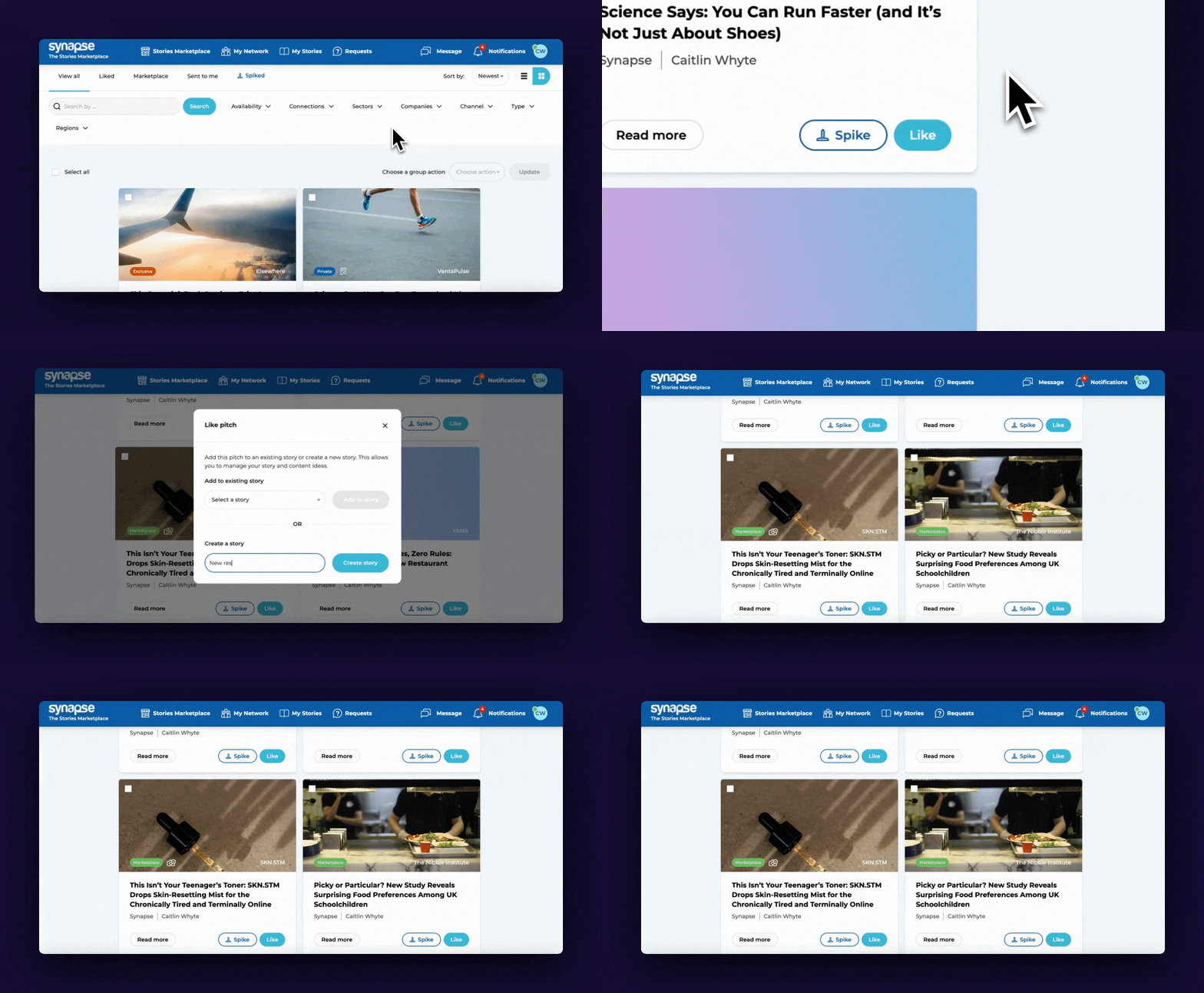
Our latest update is no different. You told us what slows you down, what you wish you could see at a glance, and how you’d actually prefer to interact with pitches. So we listened and built exactly that.
Here are three new features for our journalist users now live on Synapse:
1. Spot case studies and original imagery at a glance
You’ll now see icons on pitches that indicate if they include original images or case studies.
No more guessing or clicking around. If you need assets to build a story quickly, you’ll know right away.
2. Colour-matching to your profile
We’ve added visual cues that light up when a pitch includes details that match your profile:
- Sectors you cover
- Pitch types you prefer
- Extras you care about, whether stats or celebrity commentary
The idea? Help you instantly spot if something’s a fit.
3. ‘Accept’ is now ‘Like’
Sometimes a pitch isn’t quite right, but it’s close. Maybe the expert’s interesting. Maybe the statistics have potential.
Now, instead of ‘Accept’, you can just ‘Like’ a pitch. It tells the PR you’re interested and would love to chat.
Wrapping up
These features are live right now, and they’re all based on real feedback from journalists using Synapse every day. If you’ve got something that would like to see next, hit us up. We’re here to build a better workflow, one feature at a time.
Hey there,
Can AI restore the trust that media relations needs?
Welcome to The Loop – your weekly scroll of sharp tips, journo requests and media news we know you don’t want to miss.
Before we dive in, here’s a reminder of what’s up and coming:
Join Synapse and Freelancing for Journalists for AI, Public Relations & Building Trust, a live virtual event where the experts will share practical tips on rebuilding trust and using AI responsibly. There’ll be plenty of time for your questions too!
When? On July 2nd, at 12 pm on Zoom.
Here’s what’s landing this week…
🔥 MUST READ
…advice we’ve spotted from the experts
“PR knows the media has changed, but are we moving fast enough to keep up? (Spoiler: probably not)”
Lauren Phillipou calls out how even as journalists branch into podcasts, newsletters, and video, many PR teams still pitch like it’s 2018, saying it’s time to evolve approaches for today’s formats.
👉 Read the LinkedIn post
🔎 JOURNO REQUESTS
Here’s what journalists are currently looking for on Synapse:
Insider Media:
- Looking for all dealmaking-related announcements from B2B press teams in the West Midlands area – legal, accountancy, and corporate finance advisers
- Seeking dealmaking news from Dorset-based professional services – legal, accountancy, and corporate finance firms.
Metro:
Express:
LADbible:
- Looking to speak with a health expert who can comment on the health implications of unregulated, illegal vape use.
- Looking for urgent doctor commentary on the reality of what rubber bullets can actually do to your body.
- Looking for a mental health expert for a comment on dealing with panic attacks
The Sun:
Daily Mirror / Express / Reach titles:
The i Paper:
- Looking to speak to someone who has moved away from the UK for financial reasons and doesn’t regret it.
- Looking to speak to someone who wouldn’t put their money in stocks and shares over a cash ISA.
- Looking for expert comments/case study of someone in one of the vulnerable groups that have lost out on the winter fuel payment u-turn for
- Looking to speak to someone who keeps physical cash at home, hidden away safely, for emergencies.
- Looking to speak to someone who received a higher inheritance tax bill because they disputed the value of their property.
Or head to the marketplace now to look at requests yourself.
🗞️ PR-Y STUFF
Here’s what we’ve read this week so that you don’t have to:
- If you’re not earning a reaction, you can’t win – Weber Shandwick’s president on why real impact means earning attention, not just buying it – and why the best ideas don’t chase headlines, they create them. read more
- JIN’s Edouard Fillias on replacing himself with AI – In this episode of ‘The Agency Leader’ Podcast, Edouard Fillias talks AI, efficiency, and why comms leaders need to rethink their own roles before tech does it for them. read more
- PR agency’s lottery winner pitches raise eyebrows – Press Gazette digs into a PR agency’s campaign pitching “lottery winners” to publishers—only to find many of those winners mysteriously vanish, sparking questions about transparency and ethics. read more
- Just Curious: Reimagining PR’s future with David Gallagher – PR veteran David Gallagher maps out how decentralised models, AI and geopolitical shifts are reshaping the industry and why community, flexibility and purpose will define its next chapter. listen on Spotify
📆 NEXT MONTH’S HOOKS
…just because we don’t want you missing out on stuff.
- 1 August: Edinburgh Fringe Festival begins
- 1 August: ‘The Bad Guys 2’ movie release date for the UK
- 7 August: Bank of England MPC Base Rate decision – It will be reviewed to determine interest rates set by lenders and savings providers
- 8 August: ‘The Naked Gun’ release date – A reboot starring Liam Neeson, directed by Akiva Schaffer.
- 9 August: Edinburgh International Book Festival begins – featuring everyone from the rising stars of fiction to Nobel Prize-winners
- 14 August: University Clearing search peak – Searches for ‘Clearing’ spike here. Smart PR timing for universities, fintechs, student accommodation and retail brands aimed at young adults.
- 14 August: UK economic announcements – Balance of Trade, Gross Domestic Product, Index of Services and Industrial Production announced.
- 21 August: GCSE Results Day – MailOnline’s social platforms reach 2 in 5 school leavers. BBC’s informed that students will receive their results via the Education Record app this year.
- 21 August: Reading & Leeds Festival begins
- 22 August: Women’s Rugby World Cup starts – London, Bristol, Sunderland, Brighton, Northampton, Exeter, Manchester and York are the host cities.
- 24 August: Notting Hill Carnival
- 27 August: ‘School shoes’ searches peak – According to MailMetro Media, 46% of parents use payment schemes for back-to-school items.
✨ BEFORE YOU GO
Got something brilliant but in a rush?
Send it over to pitches@synapse.media and we’ll get it in our marketplace for you.
Synapse – the only stories marketplace for PRs and journalists – today announced two major appointments to its leadership team as it accelerates its growth across the UK media and communications landscape.
Mark Gallagher, founder of the strategic communications agencies Riverside Advisory and Pagefield joins the Synapse board in July. One of the UK’s leading communicators, campaigners and political lobbyists, Gallagher brings a wealth of experience and an unparalleled network of relationships across journalism, public affairs, and strategic communications. He sold Pagefield to DC based PPHC in June 2024 and remains a Senior Adviser at the agency. A former Director of Public Affairs at ITN and ITV plc, his appointment signals a significant step in Synapse’s mission to deliver cutting-edge technology directly into the hands of journalists and PR professionals across the UK.
“Synapse is a deeply impressive company, with a great product, ever deepening partnerships, and a stellar board and executive team. I didn’t hesitate to join them.”
“We’re excited to welcome Mark to the board,” said Charles Russell, CEO of Synapse. “Mark’s insight and influence within the media space will be invaluable as we continue building the most innovative solutions for both PRs and journalists.”
Mark joins an elite group of industry leaders on Synapse’s Board, including PR legend Mark Borkowski and its chair, advertising and media leader Rupert Howell. Dowgate Capital continues to advise on fundraising and corporate strategy.
In addition, Lloyd Embley, existing shareholder and board member, will be joining the Synapse management team as Executive Director. Formerly Editor-in-Chief of Reach plc, Lloyd will bring his extensive newsroom leadership and editorial expertise to the forefront of Synapse’s product development and strategic direction, with a particular focus on enhancing the platform for journalists and media organisations.
“Lloyd’s transition from board member to executive reflects our shared belief in the transformative potential of Synapse,” added Russell. “His deep understanding of newsroom workflows and editorial challenges will play a critical role in shaping tools that truly meet the needs of the industry.”
These appointments strengthen Synapse’s commitment to solving decades-old problems for modern media professionals through smart, collaborative SaaS technology. With a growing user base and strong platform adoption among UK journalists and PRs, Synapse is poised to become the go-to platform for story collaboration in a digital-first world.
