
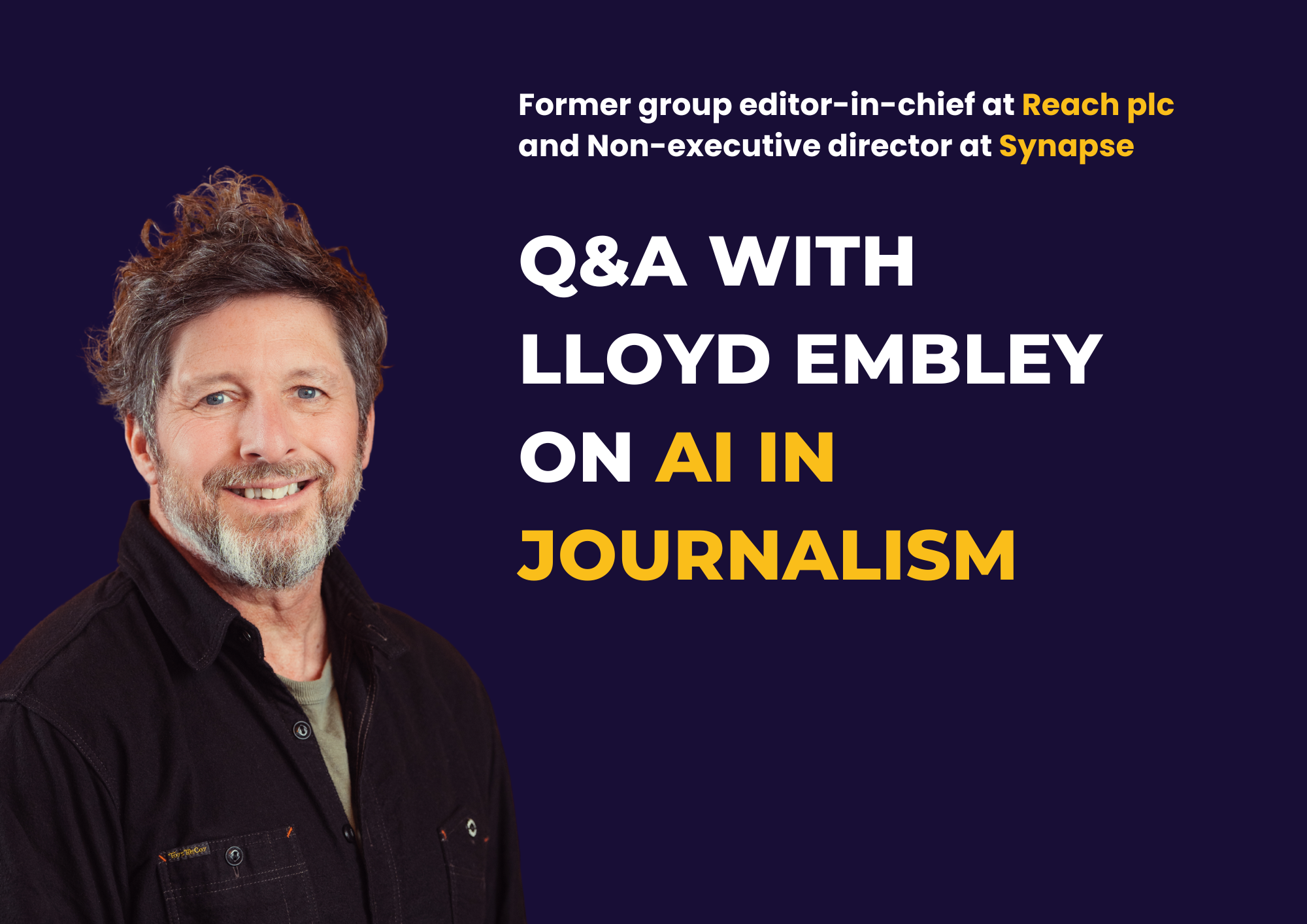
This Q&A was originally shared by Freelancing for Journalists as part of our ongoing partnership, and we’re thrilled to publish it here too. You can check out their brilliant work over on their Substack or their website.
Everyone has a viewpoint on how, when and if AI should be used in the newsroom.
So we recently caught up with Lloyd Embley, former group editor-in-chief at Reach plc and now a non-executive director at Synapse, to speak to him about AI, the importance of accuracy and trust, and how freelancers can benefit from these new technologies.
With years of experience in the media, Lloyd’s insights carry a lot of weight, especially when it comes to how AI is changing the industry, so read on to see what he had to say.
Q: AI is a hot topic in journalism right now, so what are the key elements of Synapse’s AI tool?
Lloyd: Yes, everyone’s talking about AI, but it’s not a new concept. It’s already impacting workflows, helping journalists work faster, whether through transcription tools, research assistants, or automated summaries, and assisting in newsrooms. The range of AI tools available is already huge and there will be a different tool to assist, no matter the pain point.
That’s not to say that AI shouldn’t be approached with an element of caution. A tool which may appear to make life easier is of zero value if journalists cannot trust it. Worse than that, it could destroy the essential bond of trust between journalist and reader.
The greatest fear is AI ”“hallucination”—the generation of inaccurate content and/or pulling from unreliable sources.
Synapse has two core AI elements within the platform. Firstly, AI-assisted press release summaries and generative tools, and secondly, AI-powered matching, which will ultimately mean that journalists receive more relevant PR pitches just by using Synapse regularly. Crucially, our generative tools are “hallucination” proof.
Q: As you say, trust is key, and AI tools in journalism have raised concerns about accuracy and security. How does Synapse address this?
Lloyd: The concerns are completely understandable. If trust goes, it’s game over.
The key thing about Synapse’s AI is that it is not able to generate facts or pull in information from unknown or outside sources. It is a closed box approach, meaning our press release summarisation tool and our generative AI tool work only with the material you give it, meaning it won’t introduce errors or “hallucinate” facts.
We also don’t allow our users to query our model, which means that our AI can’t learn inaccuracies.
This closed approach is crucially important. The model has been carefully designed to ensure it can only learn about the kind of stories and topics each individual journalist is interested in and their unique writing style.
Q: How does this benefit freelance journalists in particular?
Lloyd: Freelancers have to do everything themselves – from finding stories to chasing invoices—so time is their most valuable resource.
Maintaining a steady pipeline of work is challenging, so anything that speeds up admin, research, or case study sourcing can make a real difference.
AI tools can take some of that workload off your plate by making it faster to scan press releases and spot relevant stories. And because PRs on Synapse are using AI-powered matching to be more selective with their outreach, freelancers will see fewer scattergun pitches and more tailored, useful leads. AI can’t take everything off your to-do list, but it can be an incredibly useful tool in freeing up a portion of your time to focus on what matters most.
Q: What’s next for AI in journalism?
Lloyd: AI developments are going to continue to move at an incredible pace. I think there will be extensive leveraging of powerful LLMs (large language models) and an increasing number of ways in which AI, particularly agentic AI, will be able to solve more and more complex, multi-step problems.
For journalists, this will mean more powerful and intelligent tools for research, data crunching, case studies, graphics and images, design, sourcing, networking and much more.
I’ve said this already but it cannot be stressed enough, at Synapse, our absolute focus is on making AI work in a way that journalists can trust: cutting down clutter, improving the quality of PR outreach, and ensuring journalists have the tools to work more efficiently – without sacrificing accuracy or independence.
Q: Aside from helping to free up freelancers’ time, what problem is Synapse solving?
Lloyd: The sheer volume of emails landing in journalists’ inboxes every day is overwhelming. The challenge isn’t just sorting through them—it’s spotting the genuinely useful ones before they get lost in the noise. I think most journalists would be shocked at the number of databases and media lists their personal details are saved in without them even knowing.
This outdated, scattergun approach is grossly inefficient – in terms of time and results.
That’s why we created Synapse. Instead of mass pitching, PRs upload their stories to our platform, so journalists can browse or search for what’s relevant to them. Synapse has a range of filtering tools available to journalists, making this process so much faster and more effective than current practices.
For freelancers, this could help you create a setup where you use your email account for editorial pitching, invoicing, client management, and other admin, but use Synapse for story sourcing.
There’s also a request marketplace, so if you need additional expert commentary, case studies or insights to strengthen a story before you pitch it, you can call out to relevant PRs. As soon as you’re done with the request, you can archive it, meaning PRs can no longer message you. This tool is already proving to be immensely popular and useful.
Q: Finally, where can journalists try out these AI tools? And can we be selfish and ask you what your top pitching tip for freelance journalists would be?
Lloyd: Journalists can sign up for free on Synapse and start using our AI-powered press release summaries right away. The platform also makes it easy to browse relevant stories without the usual email overload and source case studies & expert voices.
I’m afraid there is no magic rule (sorry!). It sounds obvious, but pitching the right content to the right editor will deliver more consistent results and help you to develop your network. Case studies and supporting sidebars and breakouts, where applicable, will always go down well.
Remember, time pressures are enormous and getting worse, so the more lifting you can do the better. You’re providing a service, so make it as complete as possible.
Looking to change the way you work with PRs, speed up your workflow, and find more relevant stories? Then it might be time to try Synapse. Register here.